October 27, 2010

Wikipedia and Me: It's Kind of a Long Story


When I was in fourth grade I was double-promoted to fifth grade. This practice, commonly known as "skipping a grade," while lauded in some circles, did nothing but exaggerate the social misfittedness of my adolescence (which was later corrected when I went to library school). My first day of fifth grade was October 27, 1986, and every year on this day I reflect on the relative worth of that move.

I don't believe in entering into the dicey calculus of what might have been, but I do believe the whole grade-skipping affair launched me into a life of know-it-all-itude. It didn't take me all the way 'til library school to correct that one, though. That one flew out the window during my Peace Corps experience, and whatever was left after that evaporated when I took on a humbling masters program in linguistics that was my most challenging academic undertaking. (I did finish, but not with flying colors).

At one point during my first graduate school adventure, I attended a meeting of a student environmental group that was using some weird thing called a "wiki" to organize its content and calendars. This was 2003, and to put this in proper historical context, imagine that Arnold Schwarzenegger had just been elected Governor of California---during a World Series playoff game in which the Cubs scored 8 runs. (I was there, and it's one of my favorite memories.) I had not yet heard of Wikipedia, and didn't find out about Arnie on it; I heard someone shout it out in the packed corridors of Wrigley Field as heartbroken fans filed out after 11 dizzying innings.

When the leader of our student group said we'd be using a website that anyone could edit, I put my still-thinking-I-knew-it-all hand up and asked how we would control the website if anyone could edit it. His answer was, "The community will govern." Indeed, he was right.


I've never been a very good hater of Wikipedia. I probably made a half-hearted attempt at some point to be one of those librarians who frowns on folk sources, but it never stuck. It's partly because Wikipedia was not my first exposure to a wiki. I got schooled on the wiki ethos long before I went looking for data about the Dixie Chicks when I first saw Shut Up and Sing. I had no doubt I would get a good estimate when I wanted to find out how old Kirby Dick is, and I fully enjoyed reading along about the history of Paranormal Activity while I was watching it. Suffice it to say that outside of IMDB and the print version of People magazine, Wikipedia is my favorite go-to resource on matters of pop culture.

I trust that the people behind the Dixie Chicks entry were at each other's virtual throats to appropriately document all sides of the controversy. But I'm a librarian. People look to me for guidance on reputable sources, and lurking in every conversation or reference question is the notion that there may be a Wikipedia entry leading the way to a bunch of resources, or providing valuable information itself. What's a girl to do?

In my first semester of library school I heard a panel discussion in which one alum proudly announced that she sported an "I hate Google and Wikipedia" T-shirt at the middle school library where she worked. Surely this is not a solution. Later I had a great class in which the professor said, "Wikipedia is a fact of life," and encouraged us to use our library skills to fact-check and improve its articles. That sounds more like it.


Since the Facts of Life lecture, I have come to embrace Wikipedia as more than just a competing resource that my colleagues are tempted to consult before asking me a reference question. I'm coming around to it, and starting to have more courage to speak out about it. Several experiences have made this possible. One was hearing Cory Doctorow speak at ALA this summer. He said something along the lines of, "How many major newspapers alert you that an article has incomplete citations or contains information that's currently being debated?"


Another turning point for me was reading Daniel Pink's account of Wikipedia's creation in his book Drive, and reflecting on the importance of this in explaining new theories of human motivation. A third experience was reading Chris Guillebeau's manifesto, in which he laments the days of old media: "People would sit in front of the screen and watch 'the news' presented in a hierarchical fashion based on what a small group of media barons and editors thought was important."

In Guillebeau's "alternative graduate school" proposal, one of the things he recommends it to set your internet browser to http://en.wikipedia.org/wiki/Special:Randompage and read the article that comes up each day. I've been doing this for two weeks and it is both more entertaining and possibly more educational than reading a whole GAO report every month.

One last memory: it was unsettling to say the least when, on the morning of April 16, 2007, I first heard of the Virginia Tech Massacre by reading its Wikipedia page. The page was a single scroll at that point, with a rudimentary timeline and no links. It was set up before major news outlets had picked up the story and was sent to me by a coworker. This was a revealing moment in our history. The lesson here is less technical than sociological: more people are creating and sharing information. And, even though I learned in library school that, "90% of anything is crap," I think having a mass historical record created by many minds is inherently a good thing (especially when it's so well organized).
We should go forward and evaluate Wikipedia articles with the same rigor we would any other resource--no more, no less.

October 20, 2010

Information in Context

Last week after SMUG, I attended the DC meet-up of Chris Guillebeau's Unconventional Book Tour. (There's Chris in the picture to the right, which I took with my phone. While it is not of great quality, I actually own the rights to it, unlike most of the images in this blog.) It was a great chance to hear more about the Art of Non-Conformity project and meet some of Chris' 'small army of remarkable people' in DC who are leading non-traditional lives. One remarkable attendee shouted out "#AONCDC" and, Presto, we had ourselves a list of remarkable people to follow-up with after the reading.

I about made a fool of myself when I met Chris, what with being starstruck and wanting to tell him my Guinea story and all, but I managed to recover enough to answer his "What do you do?" with "I'm an embedded librarian." From there, though, things unraveled a bit and I almost left him with the impression that embedded librarians are like embedded reporters, which they are not. Chris said it sounded like I worked for the CIA or something, which led me to say, "No, think of it more as a librarian without a library," to which he replied, "So you're the Book Lady," to which I replied (re-establishing my credibility as one who can think on her feet), "No, more like the Tag Lady."

The main idea of Chris' blog and book is that you don’t have to live your life the way other people expect you to. When I wrote him a fan letter, one of the things I said was that, "This book came to me at just the right time, or maybe it's just that good." Truthfully though, the reason I got so much out of the book and started following Chris is that the information was put in context for me just the way I like it: in the form of a book review, by someone I admire and whose recommendations I trust (that person is the inimitable JD Roth).

Flash sideways, Lost-style, to a big database project I was working on during the time I read Guillebeau's book. Not only do you not have to live your life the way other people expect you to (although we sometimes need reminders and encouragement to embrace this), you also do not have to organize information the way other librarians expect you to, especially if your guiding principle is always to put information in context.

I was tasked with taking a richly structured federal interagency database designed for public input, figuring out why it was impoverished in terms of records, and then writing a "concept paper" for a new design. I did it. (Not that I didn't procrastinate as per my standard practice, but I did it and it was even, dare I say, fun!) The new design is about as far as you could get from anything I learned in library school about how to organize information (except that HTML is involved and it helps me organize thoughts). However, my guiding principles for it were to put the information in context (I am sure that came up once or twice in library school) and to put users' needs in front of my own, knowing I will be the one to implement the design I proposed.

Instead of records in a database, we will have individual web pages for each case study included. Instead of a fancy interface with scroll upon scroll of drop-down criteria for searches, we will have three simple gateways that list all records by one organizing principle (chronology, geography, topic). I will have to code all the pages, and I will have to list each record three times to ensure that they all end up in the appropriate place on each gateway, but this design will provide a better user experience by scaling back all the architecture that scared away the original users. We will favor browsing over search, since known-item searching is not a high priority for users of this database (rather, it's more of a serendipitous user experience as people will be using it to find out what is going on in this area in general, and not looking for specific program data).

It took me a while to embrace the new database concept because voices from library school were telling me to use some complex code or machinery that really wasn't necessary for this particular project. Many things here are like that, and may not even seem like library tasks to the outside world (or the inside world, for that matter). But I will approach each project as a librarian, and each project will be better for it.

October 13, 2010

Feeling SMUG

Today was the first meeting of our Social Media Users Group (SMUG). We had about eight people there out of about 14 who had been identified as using or preparing to use blogs or Twitter for official business. The meeting was structured around my colleague Kendra's wise words, "There is no exact recipe for success, but there are known ways to fail." While we enjoyed my not-so-original recipe for rainbow chip cake, we brainstormed known ways to fail, and here are some we came up with:
  • Tweeting without a picture, or changing the picture too often (in my opinion you should never change your Twitter picture);
  • Tweeting without a bio or with a bio that is not sufficiently descriptive of what people should expect from your feed;
  • The "Do-Not-Tweet" List: a need for proscriptions from above on specific content (such as ballot measures) that we are forbidden to Tweet or ReTweet;
  • Using automated share tools without knowing how they work (lest you inadvertently Tweet that you are "Currently Browsing.....");
  • Duplicating another program's feed;
  • Proliferating or initiating negative content about a partner, sponsor, funder or federal agency;
  • Using irony, sarcasm, provocative questions or ambiguous language that could be misinterpreted;
  • Accidentally ReTweeting your favorite off-color comedian;
  • ReTweeting a link without knowing what it leads to;
  • Having an ill-defined scope or voice for your blog (or none at all);
  • Having too much voice, or using an organizational blog for personal purposes;
  • Duplicating everything from your website on your blog;
  • Blogging negatively;
  • Posting infrequently or abandoning the blog altogether.

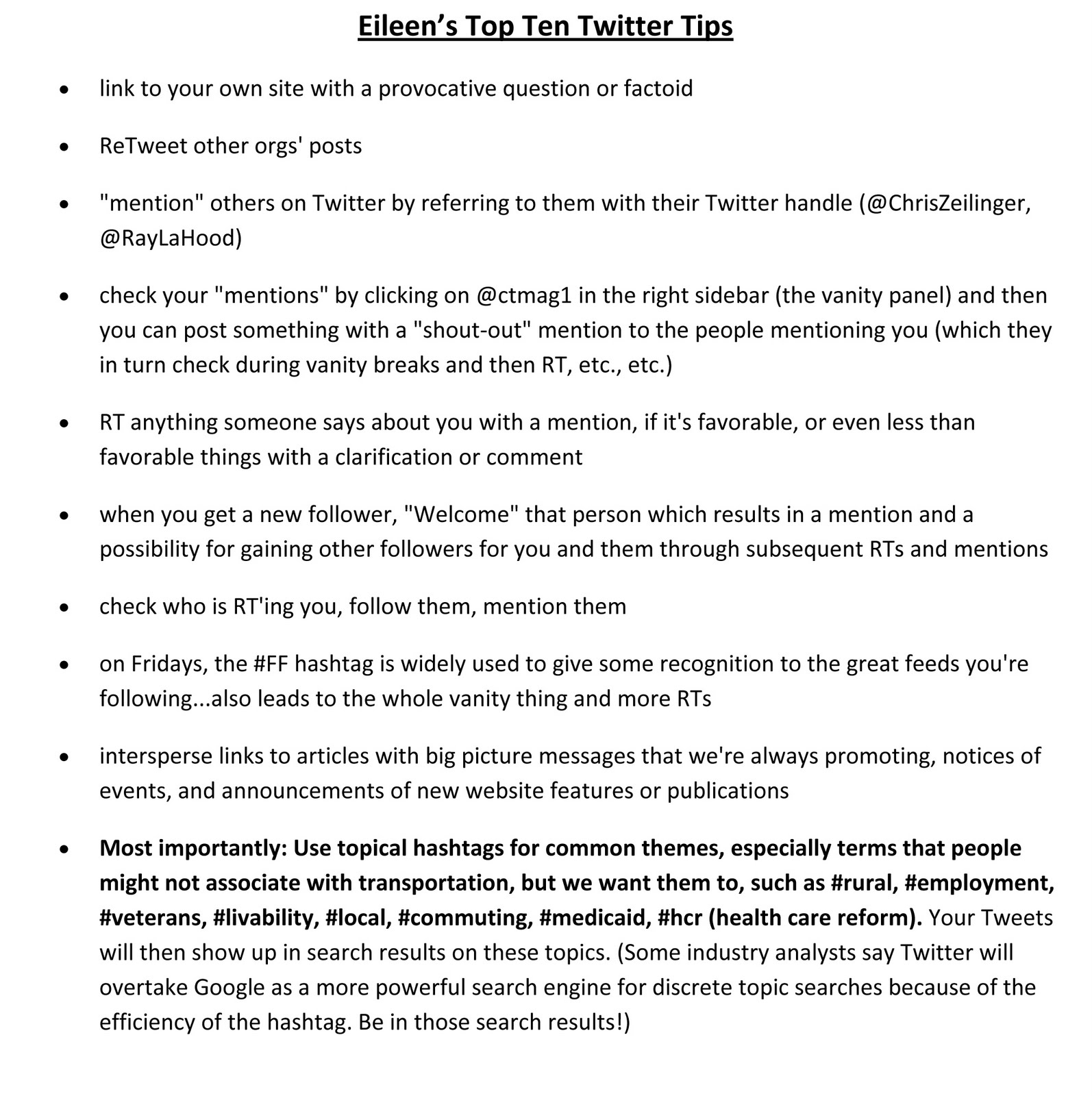
We made a list of all the current or proposed blogs and Twitter feeds that we know of and talked about the next steps for an approved social media policy. We also discussed the power of the hashtag and my top ten tips for building a following. The two best rules of thumb that I heard mentioned, for both blogging and microblogging were these: "Assume the whole world is watching," and "Be interesting." I felt these were great guidelines to get the most out of the tools and avoid most of the common pitfalls. It was a great first meeting and I hope to have more of them to blog about!

October 6, 2010

Greatest Hits

It's time to talk about hits--great ones if you'd like--but more importantly, the kind generated by Google bots and the ones oft' overestimated by your staff as genuine human interest in your web content. Lately, everyone's favorite word seems to be "hits." I keep finding myself in meetings where someone asks breathlessly, "How many hits are we getting on that page? Have our hits gone up? Are you tracking?" If you hear one of these questions, take a deep breath, put your enlightened librarian face on, and calmly explain the following:
  • A 'hit' is not as easy to define as some might think. Your own web system may define it differently from services such as Google Analytics, and you may have to wade through your server logs and crunch the numbers yourself to get an accurate count. (I'd say more, but I obviously don't know any more than this; I rely on our webmaster to interpret the server logs.)
  • Your own hits may be included in the numbers you are looking at. I don't know about you, but every time I am building a page, I check it several times in several browsers because I don't trust the preview screens. All those hits and refreshes (to fix apostrophes that are turning up as question mark diamonds) may be counted as veritable web traffic to a page. Which brings me to the next point...
  • You need to create a baseline to make sense of the numbers. You may choose to start tracking hits or growth after a certain date to filter out some of the set-up hits, especially if the page in question is brand-new. If the page is not a brand new URL but you have changed or added content, then it becomes even more important to think carefully about the date ranges you want to look at.
  • Don't track hits on pages you do nothing to promote. Marketing may not be in your job description, but if someone is asking you how a page is doing, and that page is not either (a) linked very prominently on your site, or (b) being actively promoted through some other method, do not spend time looking at the numbers until you've made some effort to drive web traffic to that page.
  • Be clear on what you are looking for in the numbers. Have you ever heard that HITS stands for 'How Idiots Track Success'? (I originally heard this attributed to Gerry McGovern, and it has also been attributed to Google's Avinash Kaushik, but I'd like to think it was first coined by Toby Ward.) I don't know if I truly believe that, but I think the extreme point of view occasionally helps move us to a more reasoned middle ground. Yes, you want to know if people are using your site, but hits could be bots not people, and even if the hitmakers are human, do you know how satisfied they were with your content? As JD Roth says, "Do you know the best way to get search engine traffic? Get linked from other sites. Do you know the best way to get linked from other sites? Write content that people want to share with others, content that makes people go, “Wow. I’m glad I found that.” That’s only SEO trick you need to know."
A website is a means to an end, not an end in itself. If you throw out some numbers that indicate page traffic is up, the temptation may be to think everyone is doing his or her job. Other forms of feedback and evaluation may be more effective unless your goal is just to generate hits. Let's leave that to the great songwriters of the world.

September 29, 2010

Day in the Life: The Three Most Important Things I Learned in Library School

I am working on a post about Information in Context, and it's taking shape while I slog through a huge database project, but I had to pause to capture this Day in the Life and the laws I cannot break myself against. There are three things I learned in library school that today seem like the three most important things. If every day were like today, then here is your guide to being an embedded librarian.
  1. HTML: Thank you, Bill Kules, for making me learn to code in HTML by hand and not use Dreamweaver! I use this skill every day in this job. And the importance of this goes well beyond just being able to help out with web tasks in a small organization. When you know code, you have a better understanding of how to organize information. It expands your imagination on all projects. Our content management system can automate a lot of things, but if you can get in there and mess with the code (or even be able to look at code without recoiling in fear), you can be a resource to your webmaster and everyone else.

  2. Web Accessibility: I cannot tell you how important it is that as a librarian you know a thing or three about how to make your electronic information accessible to people with cognitive, visual, or other disabilities. It is the perfect marriage between the person-centered approach of libraries, and the technical knowledge and skills that are increasingly important to our profession. If you are the only one in your organization singing this song, SING LOUDER.

  3. Copyright: Embrace your duty to educate your staff about their own "copy rights," and speak up if you feel they are infringing on others' rights. Your organization may routinely give its resources away for free and without a vested interest in getting credit. However, you as the librarian, and I as the librarian, and we as librarians, have to work extra hard to communicate that not everyone feels this way about sharing information. When I was in Copyright Camp during library school, the SIIA's message to me was, "Don't copy that floppy!" I feel I am slowly making a mantra out of "Don't post that PDF!" Make your staff aware that you have copyright knowledge, and if you don't have some, make a list of your questions and ask another librarian.

September 22, 2010

Advising Work Teams on Blog Projects

I noticed that I have been advising teams on blogging a lot lately, and in listening to myself talk, I decided that I know, or think I know, something about this, so here goes... If you are asked to weigh in (or, perhaps, even if you're not), here are some talking points to guide a content team toward better blog decision-making.

To blog or not to blog? Do not be afraid to ask someone to take a step back and more thoughtfully consider the decision to start a blog. You may find that people assume they should have one for their project or other misguided assumptions along the lines of "everybody's doing it." Have the conversation; the team may gain a lot just from being led through a thoughtful discussion about their current information outputs.

What will be this blog's focus? If there is not a topical focus, personal narrative structure, or unique point of view in the blog, the team may wish to redouble its efforts with current communications platforms rather than adding a blog. If the blog is meant to replace some other current output, such as a newsletter, have a conversation about whether the exact same content will be shared via a blog. This is a good opportunity to talk about blogging as both/either a genre or a technology. The team may be considering blogging just because the mechanics are easier than something they are currently using, or they may be looking to personalize their content a bit more--both good reasons for choosing to blog, but the team may not have given this any thought and may be headed down a path of repeating much of what is available on your website.

How will we build an audience for this blog? The team has probably done some work to promote (and get readers used to) other forms of communication. Do not let them assume that those constituents will just slide right over to their blog. This point is larger than just the learning curve that may be an obstacle for some members of your audience; it also has to do with building interest in the new focus of the blog, if it has one, as well as getting readers used to using comments features. (In fact, you may be dealing with a project that wants to start a blog but never even considered the comments feature...which is a whole discussion in itself.)

How will we sustain an audience for this blog? You may fulfill the important role of 'cautionary tale,' or helping people put the breaks on if they haven't fully thought this through. There will be a lot of genuine enthusiasm among some people about starting a blog, but they should resist the initial excitement and channel it into a solid long-term plan for evaluation and follow-up after a test phase. They should also think about posting to the blog for a while as practice, and slowly releasing the content to larger and larger circles, starting with internal staff (although they may heartily resist staying in any sort of "Beta" phase).

*Who will do it? This is not as simple as it sounds. It may be a team effort of people contributing posts and/or content for sidebars, even if the blog appears to be coming from a director or project leader. Everyone can help, but have a clear division of labor chart that indicates who is doing what, by when, and who the back-up person is for each task. If there are going to be multiple authors, or guest bloggers, hammer out the details of how this will work.

How often? A team may think they have to blog every day to be effective. It all depends on the focus and scope. A monthly entry may be appropriate depending on the project. Posting at regular intervals is more important than posting often. In fact, advise teams to have a white board (electronic or otherwise) to help continually plan the next series of posts, which helps people resist the urge to post something as soon as they think of it.

How will the blog integrate with our current web presence? If you have a website, or a portion of one, for this project, and you are adding in a blog, be careful. If the sites co-refer, do this strategically. If one of the goals of the blog is to get people back to your website, then do that, and do not re-post on your blog everything that is available on your website. Think about what the process will look like when new content arises and everyone is sitting in a meeting trying to decide if it should be posted on the website, the blog, both or neither.

How will we integrate the blog into our overall information/communications strategy? This is the part where you inventory all the current outputs and make sure any overlap is strategic. If you Tweet, will you Tweet the new blog posts? Is the blog replacing another current task or are additional staff and resources required? Will you use the blog to draw attention to new publications and then link back to your website? Will you discuss publications on the blog and is the blog one of your publications? What policies, such as web accessibility or company approval, that govern other communications need to be applied to the blog? If your stakeholders will think you are pushing out too much information, are the tools you're using customizable so people can select how much they want to get?

Should we use a stand-alone blogging platform? Platforms like Blogger are great, and easy to use, but there may be a clear advantage to using your own system if it keeps people on your website (or it may be a policy not to use an outside platform for official communication). Your content management system may also have built-in tools for blogging, but these may or may not make subscriptions easy for readers to unify with the other blogs they read. There are probably advantages and disadvantages either way--explore them.

What will be the role of the librarian? This is a great time for you to step up the kind of services you offer any team you're embedded with. If you are involved from the beginning with any sort of blog project, you can think about things like archiving the posts on your own server (if there is a concern about that), cataloging the entries (if applicable), and helping with tech support and troubleshooting if you know the selected software.

If you engage people on these points and they say something like, "Let's not overthink this; it's only a blog," be ready to point out (very diplomatically) the flaw in this approach. You need only point to a few abandoned and/or inactive blogs to show what can happen if people do not undertake blogging decisions with the same rigor they would a print publication. A colleague of mine once said, "There is no exact recipe for success, but there are known ways to fail." Be a resource to all the potential bloggers on your staff so their work, with your help, will be successful.

September 15, 2010

Help Yourself

I usually write about my successes. I need to learn to write more about my challenges, but without complaining.

I am a terrible cataloger. I avoid it at all costs, and when I do finally manage to do some, I cringe to look at the Date Modified on my catalog, which is just an Excel spreadsheet. I have piles on my desk, and in the library, of items to catalog. All this from someone who was lucky enough to have an actual set of the LCSH 'red books' in her office on Day 1. (Not that they are current, but still, pretty cool for a no-budget choose-your-own-adventure library job, right?)

Note: Early on in my tenure here, I was told not to catalog. And after I came to, I asked why. Basically, this is not really that kind of library. If I get something in print (or electronically, for that matter), they would rather have me share it right away with the appropriate staff member rather than take the time to catalog it. They are ultra kind people, but that doesn't mean they understand the importance of cataloging. And yes, it's partly incumbent on me to communicate that. A few months after the 'don't catalog' conversation, when I had gathered ample confidence and the right talking points, I approached my supervisor about this. We had a nice conversation about being user-driven versus being library-driven and it was very useful. As an embedded librarian, I have one foot in the content world of my staff and one foot in the library. It's a balancing act. I explained that if I am expected to find something later, then I should catalog it sooner. My memory is good, but not that good.

This is never the kind of job where there is 'no time' for something, so it's not as if taking the time to catalog would be at the expense of some other urgent activity. My supervisor and I were able to clarify that it's not a priority for anyone but me, but I am more than welcome to spend my time doing it as long as I am also delivering the deliverables, which are more reflective of the embedded nature of the position.

Now I am at the point where I definitely feel I should be doing better on cataloging but it's entirely on me -- both the desire and the responsibility -- unlike all my other work which is either a deliverable or a team-oriented task. I know I can do it, but I just don't. Despite the fancy label maker I have in my desk drawer.

So, I've decided to help myself. I have added in all kinds of things to my work routine that no one is making me do. I'm a librarian; why can't I catalog? I make myself read an entire GAO report each month, in addition to all kinds of other non-required activities. I know how easy it will be to find something once it's cataloged. I love playing around in Excel. I can do this.

I cataloged one item yesterday and one today. Each day from now on, until I have cataloged at least one item, I will keep my label maker right in front of my keyboard, which is terribly inconvenient, to remind me that this is really not that hard unless I continue to overthink it. Wish me luck.

September 8, 2010

To Do, Ta-Da, and Everything In Between

One of the quotes in my Embedded Wisdom list (see sidebar) is, "You cannot break the law; you can only break yourself against the law," and if you follow me in any way shape or form, you hear this over and over again. You hear me stumble through how it relates to my new tattoo design, why it's the middle epigraph in my novel, and why I insist on bringing it up over and over. I have not yet found a way to articulate it for best effect, but I've transcended ever questioning whether it is the most important bit of wisdom I have ever heard or read. In a nutshell, some ideas keep falling into your path or getting in your way over and over again until you recognize them.

Here is one for you: Make a To-Do List. When I try to come up with something for the Task Mastery 101 sidebar, it usually ends up being about To-Do Lists. Sometimes I hesitate to post those tips because, really, what could be more of a snooze than having someone recommend that you make a list of the things that you'd like to accomplish? But over and over again I find that it often is just that simple. Here are a few reasons I decided this was post-worthy:
  1. The act of making the list organizes my random thoughts into discrete tasks;
  2. The act of making the list facilitates prioritization and decision-making; and
  3. The act of making the list moves me from inaction to action.
If that is not enough, consider this: Keep your lists. See what you checked off and what you didn't. Build evidence of what you are actually spending your time on, and what things you did not get to because you were fixing the printer or making name tents. Write in what you actually did instead of something on your list. If someone asks you what you've been working on or what you have accomplished today/this week/this year, consult your lists. Use them to revise your job description when it's time, or to draft a work plan for your library.

Last year on the Solos list-serve someone posted a great document of what she does daily/weekly/monthly/annually in her library and it was quite detailed. Parts of that could become an intern's project description, or the scope of work for a contractor, or a part of your professional portfolio. It becomes the documentation for you and everyone else of how you spent your time, and how much time things take.

In the spirit of "something for everyone," here is a new take on an old idea, that of the "To Not Do" List, which will surely be referenced when I post my magnum opus (portions in Latin) on Selectivity. Stay tuned.

September 1, 2010

C.U.R.T.?

Can yoU Read This? Or is it "brief and incomplete to the point of discourtesy" if I initialize it instead of spelling out what I am really asking? That is the definition of curt I found in the mammoth 1940 Universal Dictionary of the English Language that I keep in my office. Granted, in a previous post I explained that my background in linguistics makes me much less of a prescriptivist than you'd expect, especially when it comes to dictionaries, but I think the general concept of curtness is an apt metaphor for what happens when we do not control one ubiquitous and possibly confounding aspect of our work: Acronyms.

I had a great teacher in library school who encouraged his students to approach Wikipedia as a "fact of life" and not an inherently bad thing, just one that librarians should use with more thoughtfulness and caution than the average user might. I feel the same way about acronyms: they are there for a reason and they can make our life easier. Nevertheless, acronyms pose obvious problems to new staff at an organization, visitors to your meetings and conferences, and even you if you don't know what they mean.

The first rule of acronyms: Ask. If you hear one in a meeting, write it in the margin of your notes and ask what it means at the first appropriate opportunity, which may be right away if it's crucial to your understanding of a task. It may be the case that you figure it out from context and double-check it after a meeting, or follow up with the person who used it.

The second rule of acronyms: Keep a list. The librarian is a key person to document miscellaneous knowledge in an organization, and making an acronyms list is a great way to start. This list will have 101 uses. Make it available via your intranet (or via a public web page if appropriate) and have a way for people to suggest or add changes. Offer it to conference organizers to include in the program if guests from outside your knowledge speciality are attending. Include it, or a relevant portion of it, in your organization's standard publications.

Think about how you feel when you get a very short email from someone without a lot of context or elaboration (especially in customer service situations) as opposed to a thorough explanation. The longer explanation usually adds to your understanding, makes you feel valued, and shows that the person on the other end gave some thought to your point of view. The same is true for acronyms. Avoid seeming curt or exclusive by giving everyone who interacts with your organization an opportunity to be "in the know" and figure out what people are saying.

August 25, 2010

Notarizing in the White Spaces

Two years ago I became a Notary Public in the District of Columbia. While my husband chided that becoming a notary is "what nerds do when they grow up," I contended that this was a natural extension of my role as a steward of authenticated information.

As the District's Notary handbook attests, the role has evolved from that of designated notetaker to one "certifying the truth" by witnessing signatures on important documents. I knew that my organization often had a need for this service, and I correctly predicted that becoming qualified to fulfill this role would help me get to know my coworkers. It's a public service you can provide that fits well with other solo/embedded duties as part of working in the 'white spaces of the organizational chart.'

You may find that a member of your finance staff is already a Notary Public, but often the documents that need to be notarized are financial in nature and so a third, disinterested party is necessary to witness signatures. I've also been pleasantly surprised by all the non-work/personal business I have received in my office, now that people know I am a Notary Public. I have probably notarized documents for half our staff and only half of those were work documents. It's been a great way to get to know people, and for them to get to know me. (I have the "Notary Public" nameplate on my desk so people know when they walk by that I can provide this service.)

Requirements vary state to state, but you will likely have to go through some level of training, provide references, get bonded, and buy your stamp(s) before you register with your state and take your oath. And, yes, you will be offered many additional customized products when you buy your stamp. But, yes, you can write off your set-up expenses on your taxes, as well as any income you make as a Notary Public (in fact, you have to declare that). While this is not a huge money-making enterprise, it's a nice complement to other skills, talents and certifications that librarians naturally have, and it's a great way to enhance your visibility in the workplace. It could be the starting point for long-term work relationships, and when people see you as a competent and trustworthy agent of the state, they tend to think of you as a resource for other matters. It's also a great way to learn about local and state laws, legal documents, and other procedures handled by state government.

Although I moved to Maryland after starting my commission as a DC notary, my employer wrote a letter on my behalf to the Office of Notary Commissions and Authentications so I could continue notarizing in DC until my commission expires in 2013, noting that this was a valued service I provide to the organization.

August 18, 2010

Works in Progress

Two years ago I wondered "aloud" whether this position was really an "embedded librarian" position, and that is still up for debate. However, one of the characteristics of embedded librarianship that Shumaker and Talley (huge final report here; summary here) note is "providing specialized information services." If I judge my current position exclusively on that criterion then I am unequivocally embedded, at least as evidenced by my two current projects described below.

Thing 1:
For one of the teams I am "embedded" with I am drafting a training on "information overload," which I am modeling around Clay Shirky's idea that, "It's not information overload; it's filter failure." I am having a lot of fun with it. This was requested for a set of part-time independent contractors who work on our behalf in the field and receive tons of electronic information from our staff, in addition to memoranda from the project director.

(Click images to enlarge.)

I was asked to craft this presentation with the goal of explaining all our electronic messaging and how these contractors can strategically use it to help and not hinder their work. I am focusing the presentation around the topics of "Filtering" and "Filters," explaining the general approach and then the tools. I want to build on the idea that we are all already using some filters whether we know it or not, but the filters sometimes have to be adjusted for the specific types of information in our intake, that being the information I am to be the "specialist" on.

Thing 2: For another team I am "embedded" with, I am helping them draft what I am calling an "Overall Information Strategy" as part of a website relaunch and renewed marketing plan. It's not supposed to be a communications plan so much as a prerequisite for a communications plan--first documenting all the information sources and then outlining the appropriate outreach that matches each (and by "outreach" I mean to include internal staff communication).

To do this, I am first documenting the OIS for the team in Thing 1 (my primary project), and it has been just as much fun as the Information Overload presentation. These are both going to be tools I reuse and refine again and again.To start the OIS document, I just made a matrix showing all the types of information that come in on one axis, and all the possible actions and dissemination outlets on the other axis. And yes, there is strategic overlap: creating a new web page could be either the cause or the result of one of the other actions, and a new publication, if it's ours, would probably have dots filled in across the board.

August 11, 2010

31 Flavorful Months of del.icio.us

It's been 31 months since Gretchen introduced me to social bookmarking through del.icio.us (now, officially, "Delicious"). Aside from Google Alerts, this is the most important free tool that I use to organize my work. I consider my Delicious toolbar to be another appendage: I need it and use it all the time, and I usually only stop to appreciate it if it's impaired in some way.

When you get really good at tagging it can be seamlessly integrated in your work and can increase your speed and efficiency considerably, all the while creating a nice metadata record of the parts of your daily web traffic that have either caught or demanded your attention. It also acts as a great search engine later for an addled brain that remembers seeing "something" on a certain topic but then forgot about it. (When I was in library school and I would forget where I read something, I used to just ask Gretchen about those info-wisps. She seemed to have an almost clairvoyant sense of my own brain's organization and could usually figure out what I was talking about.) Nowadays, if I spend any time at all on a site, I tag it.

One of the things I like about how it works, or rather, how my work behavior has evolved since I've been using Delicious, is that having tagging fully-integrated with all my online behavior helps me know in a passive, low-effort way what the hot topics have been. Then when someone asks what theme we should focus the next newsletter on, I can contribute meaningfully by saying something like, "Gee, there seem to be a lot of things going on right now with women in transportation." It has also been very interesting to see my tags develop as new topics shape our field. My bookmarks for ARRA, livability, and Mobility Management have grown steadily as our projects and work plans have developed over the past year.

Since I asserted in a recent post that one of my guiding principles is not to complain, I will try to frame my Delicious Dilemmas as questions rather than gripes. One of the things I wish I could do is bundle tags so that, for example, if I tag something "Rogoff" it automatically gets tagged "FTA" as well (but not vice-versa, or this would be a true redundancy...I just want to reflect subset-superset relationships). Is there a way to do that? I have finally learned how to search for tags within tags, but I would also like to have some kind of option to apply them that way, which I realize would require a lot of concentrated set-up time. (Or to search by what the first tag was that I used...yes, I know, this is starting to sound like a love song for actual taxonomies.)

I also wish you could bundle tags to apply to more than one resource while you have all those related windows open. For example, sometimes I follow a story or an issue and I have several windows open that I want to tag with the same ten terms, usually when I am doing research for a staff member and I do administrative as well as topical tags. Is there a way to do this? As a short-term work-around I have adopted a simple copy-and-paste method through Notepad so I can insert a string of terms in the Tags field as soon as the Save-a-Bookmark window opens.

I love my tag cloud. It's the best portrait of what I've been looking at and working on, and it's a good reflection of the strange slice of the transportation world that I am charged with researching. It also reflects the idiosyncrasies of how I think in this place, and how our vocabulary might diverge from a traditional controlled vocabulary. “Recommendations” means something like a GAO report or a policy proposal, whereas “Recommended” is my shorthand for all those links my boss sends me that I deem important but not urgent. Also, I am finally in the habit of using my "Ready Reference" tag for all those publications our staff quote all the time, have taken pains to post in strategic places on our website, but occasionally want to see links to all in one place.

My bookmarking is only marginally "social" although I am starting to use it in that direction, and now that I am very familiar with the "back end" I think I am ready to do more sharing of the "front end" with staff so they can find things they know I have without having to go through me if they don't want to. I have not experimented with Digg or Stumble Upon but maybe I will. (But I have a feeling that that comparison may lead to breaking, or at least bending, my 'Don't complain' principle.)

August 4, 2010

Transferable Skills Part 2: Getting to Know Your Government, or "A Librarian's Love Affair with the Government Accountability Office"

One of the best parts of this job is getting to know how our government works, and in particular how it works with non-profits.

My employer is a non-profit membership association, a 501(c)(3) operating on members' dues, conference and training revenues, publications income, and some federal funds. The federal monies are harder to understand and this requires several lessons in government I haven't completed yet, although I have begun my study. Some of the federal funding comes through earmarks, one of those words, like lobbyist, that some think connote waste or inappropriate spending until you find out all the different things they pay for and then you realize that the terms are just neutral: all kinds of groups and projects, including libraries and librarians, could be funded this way.

I have also heard a thing or three about "appropriations" and "authorizations" when it comes to how some of our projects are funded, and sometimes it depends on whether the project is funded by DOT, DOL, HHS or USDA. This part is a bit trickier and I won’t pretend I understand it yet.

Then there is the much beloved set of terms that describes the contractual relationship our association has with a given federal agency for a given project. This could be a “grant,” or a "contract" or a "cooperative agreement" or other type of relationship. Knowing the quirks of all these arrangements gives me great insight into how other projects run in Washington. Yes, it's all much more complex than I could have imagined growing up in the Midwest when the White House seemed like a strange majestic icon. Now that I work two blocks from it, and realize how much smaller it is than my office building, I have a much different perspective about what goes on there, at the other end of the Mall, and in all these buildings in between.

One great resource I have used to educate myself about the actual workings of government as they affect our association's work is the Government Accountability Office (GAO) and its stellar report services. Each week I get a handful of alerts of GAO reports, legal decisions and testimony before Congressional subcommittees. These resources cover topics I have chosen through the GAO alert service (transportation, education, and information management, to name three). I also get a Month-in-Review email that I pore over to find any great pubs I may have missed.Geek alert: I love reading GAO reports. This is great writing, folks. And it's not mystery writing: the report titles tell you exactly what the upshot of the report is, the highlights pages (always first after the title) are clear, consistent and readable, and these reports are expertly edited, formatted and abstracted (bonus!). They make reference to fantastic federal resources such as the National Youth in Transition Database, and each report comes with a list of relevant acronyms.

In addition to learning the actual subject matter of a particular report, you get to know how government accountability works in general and you begin to intuit what other processes and entities have been investigated so the GAO reports database becomes a go-to resource for many topics. You will find yourself thinking, "The GAO probably did a report on that; I will look it up and track it down."

The GAO site announced last week that it has gone mobile. This means I can spend even more of my free time reading reports like my July selection (which I did finish!), and this great one selected as my August must-read GAO report. I once posted a GAO report to my old apartment building's list-serve (about some topic that was pressing in our community at the time) and my neighbor said, "I work for the GAO and I know how much goes into those reports. I am so glad somebody actually reads them!" Well, I am so glad somebody actually writes them.

July 28, 2010

The Events Calendar is a Collection.

As part of my other duties as assigned I manage an events calendar. It's easy to think of this as just another administrative duty that falls in line somewhere near the name tents, although requiring slightly more advanced computer skills (it runs as a database in our content management system, WebArticles, and appears in three different sites' customized style wrappers). Actually, though, the events calendar is another collection of information deserving of some concentrated attention, planning, and library skills.

The events I collect and post may be webinars, conferences, legislative rallies, colloquia, meetings, calls for papers, and other items of interest to our staff, members, partners, and the general public visiting our site(s). Managing this calendar has not always been my responsibility but I have taken it on with a perspective of collection development. I mine all incoming publications--print and electronic--for events that could fit the scope of our calendar. I am selective, as I would be with keeping and promoting publications. I am consistent, in terms of how I make decisions about the scope of events that would be appropriate. (We do not, for example, post all things transportation.) I also try to be consistent in how I present the information so that the metadata, as it were, for each event is displayed the same way for each event. This includes the sponsoring organization, date, location, link to registration, and any publications that participants are encouraged to review in advance of the event.

This last point is key: events are often tacked on as a way to promote a new publication, so I may as well promote the event when I promote the publication. Events also sometimes lead to publications, such as proceedings from a conference or a report on a national online dialogue, so being aware of the events keeps me appraised of where the next important pubs will come from. You can also use a well-managed events calendar to drive traffic to other parts of your website. If it's your own calendar you can feel free to work in links to your own resources.

Taking the events calendar seriously can advance strategic partnerships, organizational alignment, and future collection development. While the calendar events are ephemeral, they typically arise from fertile research questions in the field and often produce resources, at least some gray literature. It lets you know what people in your content area are talking about, giving you and the staff you serve a competitive edge, or at least a sense of being in the know.

July 21, 2010

Balance

I don't require much in the way of specialized or expensive office supplies but I'm a big fan of plastic sheet protectors. My "ready reference" library on my desk consists of about fifteen pieces of paper that I regularly refer to, each in its own plastic sheet protector, and lovingly housed in a magazine holder within my reach. There I have a list of webpage IDs for content I frequently update, a page of Microsoft Office Keyboard Shortcuts, timesheet and other internal billing codes, contact information for other members of the Eastern Transportation Knowledge Network (when in doubt, ask another librarian!), and a copy of my job description. I also have an article from last summer's Information Outlook entitled "What's in a Name?" by Mumtaz A. Anwar.

Although I opposed the proposed name change to Association of Strategic Knowledge Professionals, I held onto this article about professional identity because it contains a passage that I like to read often enough to warrant this document's close proximity to those other plastic-protected items: "I am supposed to possess the necessary knowledge, skills and attitudes to identify, evaluate, select, acquire, organize, maintain and disseminate relevant information for the use of my clients."

I think about this a lot when I need to refocus on what I am supposed to be doing with my day, my career, or just a free hour. That passage helps guide me back into the white spaces, where I long to act as a strategic knowledge professional, and very often I succeed. (This week the main project I work on published a paper I wrote about search mythology in our content specialty.) But the fact of the matter is that I am still a librarian with a sense of some of the mundane tasks that will keep the library alive and well.

No one who has met me would say I am anything short of an idealist, but when I read that passage I also have to remember that I was hired to do a specific job that is not in the white spaces, which has among its listed duties such things as "Receiving, responding and maintaining records on telephone and email inquiries on diverse topics of public and community-based transportation issues." I sometimes neglect the more quotidienne and less glamorous aspects of my work as I venture out into the choose-your-own-adventure aspects of it. (I even suffer from regular angst every time I am asked to make a name tent.)

I think we need to learn to carefully balance the regular duties our employers expect us to do with the more exotic ventures, and I don't think this is easy by any means. If we spend all our time in the white spaces we overlook some of our most important duties (no, not the name tents, but perhaps some of that record-keeping). I recently read something that said you cannot achieve balance in the short-term but only over the long haul. I think it's coming, and blogging alternately about tools and tenets surely helps keep me grounded in both Dr. Anwar's vision and my job description as written. Maybe the next step is to get all of those little tasks automated to the point where my job description could be rewritten!