January 12, 2011

My Embedded Librarianship Project


Have you ever been too tired to take your contact lenses out at night, and so you stay up even later to avoid doing it? I have. Allow me to explain what this has to do with embedded librarianship.

At some point last year I became passively aware of a person named Gretchen Rubin who had written a book called The Happiness Project. Without knowing too much about it, I decided it was way too sappy for my tastes and I duly avoided learning more about it. Don’t get me wrong, I enjoy being happy. Much of this blog is devoted to my own reflections on how to be happy at work. But I thought (without thinking too hard) that I would probably hate a book called The Happiness Project and that I would gain little by learning about its author.

Around the same time, I was “getting religion” about my debt by reading Get Rich Slowly, a personal finance blog about how people behave with money (as opposed to how money behaves in the stock market, for example). Something about JD Roth’s insistence that money management is a daily personal exercise—not a philosophy, as I used to ignorantly believe—led back to Gretchen Rubin, both literally and figuratively. I discovered a whole online network of bloggers devoted to Goals, Accountability, Money, Stuff and Time that includes Rubin, Roth, Chris Guillebeau, Leo Babauta, Courtney Carver and many others. (And they sometimes use capital letters to indicate how much mental energy we spend on things like "Stuff".) While I was still hesitant to check out Rubin’s book, I started following her blog. And that has made all the difference.

Rubin writes about happiness. And just as JD Roth’s exemplary daily writings on personal finance don’t launch readers into shame, blame, and angst at the very thought, Rubin’s daily tips and practical suggestions are indisputably helpful. Most importantly, she is not sappy. Just watch one video of hers and you will know what I’m talking about. She popularized the notion that making one’s bed every day results in greater happiness. (I dare you to try it for a week.)

I admire Rubin for consistently pointing out that everyone’s happiness project will look different. I am now reading the book, and I realized that I started something of a happiness project three years ago when I started this blog. It was initially a way for me to document my adventures “working in the white spaces of the organizational chart.” But what sustained this project was my realization that I am collecting work habits, productivity resolutions, and other heretofore well-kept secrets about flying solo as a new librarian.

Embedded Librarianship projects based on The Happiness Project will have as much diversity and variability as the librarians undertaking them. Every Wednesday is “Tip Day” on The Happiness Project blog, so I naturally think about each week’s tip on Wednesday nights while I am blogging. That’s what works for me. One week the tip was to try a “boot camp” approach to an activity you’ve been dragging your feet on. I used this to jump start the cataloging I had been avoiding for so long. (Yes! Catalog for an entire day to get yourself rolling.)

Today’s tip is to hold yourself accountable. While Rubin uses a Resolutions Chart to do it, I’m a big fan of to-do lists. (And as for my personal finance journey, I have a small, unavoidable copy of my financial goals in my wallet.)

Gretchen Rubin, like me, sings every morning.

Recently I considered Rubin's suggestion to try a Week of Extreme Nice, and I was already thinking of how to adapt this to the workplace. I decided that I would try a Week of Extreme Slow. Once when I was rehearsing for a play, the director had me practice my monologue at an ultra-slow pace for an entire week to focus on the emotion in each syllable, pause and facial expression. I think of this as an analogy to trying a Week of Extreme Slow at work, which will enable me to document the procedures I use, give more concentration to library tasks that I tend to lazily breeze through, and ask in-depth questions about the complexities of our work that I have never understood. A word of caution, though: You definitely need to pick the right week to do a Week of Extreme Slow without falling behind.

What would your library happiness project look like? There are little picky things in mine that are geared toward ending some bad habits (kind of like Rubin’s resolution to take her contacts out before she gets too tired.) I am also trying to incorporate more pro-active, positive measures, such as having a tech tip on my white board that people will see when they walk into my office. Another concrete step I’ve mentioned here is to start telling your colleagues about SLA annual conference as soon as you register. This way (ideally) they will be more interested in what you’ve learned there once you return. Let me know in the comments what your project would be like. And keep smiling.

January 5, 2011

Why Blogs Die

“There’s never an egg timer around when you need one.” ~The American President

Last September I wrote about professional blog projects. I suggested that they are often conceived to keep up with proverbial Joneses, and also that they are doomed to failure absent careful planning and consideration. I was not wrong, but I understand the problem better this week. Blogs die for the very same reason they are born: it’s so easy.

In his new book Cognitive Surplus, Clay Shirky begins by laying out a simple, captivating summary of the history of American book publishing—one I’d have been glad to have at my disposal during my History of the Book course. To introduce the larger context of his argument, Shirky frames publishing in economic terms. Pre-Gutenberg, books were prohibitively expensive to reproduce in volume. Post-Gutenberg, the folks who owned the means of production still had such a sizable burden to shoulder that their job became a matter of both selecting and producing written texts for readers (not to mention promoting said works to said audiences). This is, needless to say, no longer the case in the world of new media Shirky shepherds us through in his (excellent) book.

Both the beauty and the curse of a blog project in its infancy is the lack of accountability. The barriers to “entry,” or publishing, do not include the time and expense of a print publisher or even the US Postal Service. These are accountability measures, with their own inherent deadlines, that we set up for ourselves in professional budgets to bind ourselves to the organizational mailings of old. We could be pushed through our own hoops by the beneficial entrapments we set up for ourselves by saying, “Let’s do a newsletter,” and then carrying out the various stages of that process. Blogging requires no such advance planning. Though, as I continue to believe, it would be all the better for it.

Blogging also confuses the lines between production and promotion for staff who think it's just a matter of pixilating a newsletter. Organizations can fall prey to thinking the two are similar simply because a blog is online, and that, “If you build it, they will come.” Organizational blogging may have to be a team effort, and the voice of the author--whether co-created or not--might be separate from the voice of the promoter. (Hint: This is also true of print, but somehow it doesn't cause as much confusion in the print medium.)

As expected, the would-be bloggers I cautioned not to promote themselves before producing a certain amount of content have been dormant for a number of months. But since I am not here to complain, I will offer a solution as opposed to an I Told You So.

Why blogs die is not the same as why blogs fail. I do not even know if a blog can fail, but anything is possible. Blogs are easily born, but even more easily reborn. As once proven here, a blog can be resurrected with very little initial effort, in terms of the technology. A project team need only revisit its original goals, division of labor, timeline, and promotional strategy to live again in the blogosphere. Whether it’s your own blog or someone else’s, think of the new year as a time to reboot. Keep blogging.

December 22, 2010

Tag, You're It.

Well.

This post was originally going to be called "End of an Era," but not only was that already used for several articles on the topic at hand, The End is not as certain as it seemed last Thursday.

Long story short: A Yahoo! meeting slide that showed Delicious as one product to be axed was leaked last Thursday on Twitter and the rest... Let's just say it went the way of Internet rumors and then morphed into a scrumptiously unorganized (though not disorganized, thanks to Twitter hashtags like #SaveDelicious) grassroots "campaign" to send Yahoo! a message.

By Friday morning the news was a patchwork of conjecture, export instructions, and lists of alternatives from Amplify to Zukmo. There were premature obits, emotional laments, memorable tweets, bold assertions that we should have seen it coming, or that we shouldn't rely on free food, and a pointed question from the Washington Post: If this many people love Delicious this fiercely, why can't Yahoo! figure out how to make some money off it?

Yahoo! has still not released an official statement. The Delicious blog confirmed that something was going on, but very little in the way of actual information was provided last week, and below are 1,000 words from the Delicious blog today:

As for me, Yes, I traveled through brief devastation, acted the town crier, set up news alerts, and roped Gretchen into a Farewell, Delicious happy hour. Then I calmed down and started reading as much as I could in order to filter fact from fiction.

My tagging reflexes have taken a hit this week...my bookmarklets are like another appendage, and let's just say it's in a sling right now. I haven't bookmarked anything since Thursday because I didn't want to add to my collection (lingering hysteria mixed with a bit of conservatism for the future) and I didn't want to commit to a new service. One upside was that my tendency to tag everything remotely interesting as "TimePermitting" was tempered, so I had to refine my criteria quite a bit for what I truly thought I would read later. (For all those articles, I emailed them to myself using my AddThis toolbar...it made me much more selective and much more likely to read the things I had grabbed.)

I enjoyed the absolute Meta of seeing articles about Delicious tagged in Delicious, which was more fun than Facebook groups protesting Facebook or tweets about Twitter. It showed that this is a community of users whether you like it or not. I felt part of something, and not primarily because we were venting in unison, but because we were sharing: tips, thoughts, and memories.

(And by the way, I saw some funky versions of the Delicious logo...I'm not sure if that was stylistic in nature or maybe intellectual property paranoia, but don't forget you can use Photoshop to find the exact color mix of an image.)

December 15, 2010

INTJ

"Extroversion: The act of turning outward; the condition of being so turned."
~The Universal Dictionary of the English Language (1940)

My mentor Dave Shumaker over at EmbeddedLibrarian.Wordpress posed the following question last week and I can't help but respond: Can introverts succeed as embedded librarians? His answer was a resounding Yes, and mine will be, too.

As is my standard practice, I will start with two disclaimers: (1) I do not claim to have any knowledge of this topic except first-hand knowledge from my own experience; (2) I acknowledge than many people would not consider me introverted. However...

When I read Dave's post last week I stumbled down undergraduate memory lane. In college I did a double major in French and psychology, the latter being somewhat of an afterthought and a major academic challenge for my (then) anti-science brain. The best psych course I took was Tests and Measurement. As things came to pass, I ended up with a job in educational testing before I went to library school--to the delight of my Tests and Measurement professor. In this course we basically ripped apart every reputable test, including the Myers-Briggs (now MBTI), and we learned to think critically about testing in general. I took this a step further and approached every known assessment with skepticism and disdain. Dave's post made me realize that it was high time for me to revisit Myers and Briggs, at least as an exploratory mission to respond to his post. Lo and behold, I am an introvert.

I had started to suspect as much. Dave makes the crucial point that folk definitions of introversion and extroversion are not sufficient; it has more to do with where you find energy and insight. As for me, it's true than when I'm with others I tend to talk a lot (and loudly), but I enjoy spending time alone more than would likely be healthy for a true extrovert. As my neighbors will attest, I prefer to spend my commute reading rather than discussing local politics (although I will be forthright in saying so), and my coworkers will tell you that I have my headphones on whenever I am at my desk, drawing a lot of strength from my own reactions to music.


My "I" score was not as clear-cut as other dimensions, but it would be dangerous to correlate that with a measure of success in embedded librarianship. True, I often speak about "walking around the office asking people what they are working on," which may sound like a behavior tipped toward extroversion, but where do I get the courage to do that sort of thing?

The real "E" in this job has been entrepreneurship. I had very little to build on except my own skills and strengths. There was so little structure that I had to go out and find staff members to collaborate with, and to learn from. But it was in equal part a matter of deep and careful reflection on how to make my way here, what I had the capacity to do, and what would be of service to others. (Service is perhaps another way to view the "outward turning" in the 70-year-old definition of extroversion above.)

It would be interesting to look at correlations between MBTI scores and entrepreneurial activities, as well as "measures of entrepreneurialism" as a characteristic of embedded librarianship.

December 14, 2010

(Special Edition) My Year in Books: 2010

My book life this year, by the numbers:

I finished 22 books, nine of which were fiction, and 13 non-fiction. Five of these were memoirs, and three were books of short stories. Nine were written by male authors (2 by Kurt Vonnegut), and twelve were written by female authors (4 by Lorrie Moore). One was written by a man and a woman (Your Money or Your Life). I published a review of If We Can Put a Man on the Moon in a trade magazine for transit professionals.

I met one author: Chris Guillebeau. (See photos from the DC stop of his Unconventional Book Tour.) I contacted five authors besides Guillebeau: Marlee Matlin, Lorrie Moore, David Carr, Michael Idov, and Daniel Pink. I heard back from Marlee Matlin, David Carr, and Daniel Pink (and Michael Idov reTweeted me – does that count?).

THE BEST BOOKS I READ IN 2010 are:
(Fiction) The Help by Kathryn Stockett and Ground Up by Michael Idov; and
(Non-Fiction) The Wordy Shipmates by Sarah Vowell and Lessons in Becoming Myself by Ellen Burstyn.

Here is the entire list:
(*=highly recommended)
1. I’ll Scream Later by Marlee Matlin
2. Her Fearful Symmetry by Audrey Niffenegger
3. The Wordy Shipmates by Sarah Vowell*
4. Who Will Run the Frog Hospital? by Lorrie Moore*
5. If We Can Put a Man on the Moon by Bill Eggers and John O’Leary
6. Like Life by Lorrie Moore
7. Emergence by Steven Johnson
8. The Help by Kathryn Stockett*
9. Self-Help by Lorrie Moore
10. Jailbird by Kurt Vonnegut
11. Novel About My Wife by Emily Perkins
12. The Night of the Gun by David Carr*
13. Lessons in Becoming Myself by Ellen Burstyn*
14. Anagrams by Lorrie Moore
15. Ground Up by Michael Idov*
16. Your Money or Your Life by Vicki Robin and Joe Dominguez*
17. Cleaving by Julie Powell
18. The Art of Non-Conformity by Chris Guillebeau
19. The Case for Books by Robert Darnton
20. Drive by Daniel Pink
21. A Man without a Country by Kurt Vonnegut
22. Lucky by Alice Sebold*

Some of the books burning a whole on my shelf for 2011 include Your Money: The Missing Manual, There Will Be Rainbows, Only the Super-Rich Can Save Us, Sundown Towns and The Happiness Project. Stay tuned.

December 8, 2010

Ten Weeks to Prepare and Ten Seconds to Tweet


When I was in library school, wading through Bopp & Smith's tome on reference, I read something about the responsibility of the public librarian to "index the community." It was a passage about how a librarian fulfills a role much like that of a hotel concierge in some communities. This phrase stuck with me, likely because when I was in high school planning my majors in French and communications (one of which came to fruition)--loving learning the ins and outs of Chicago city blocks--I wanted to be a concierge when I grew up.

While I do love showing DC visitors the best pizza place and tea shop in town, I became a librarian, not a concierge, but I'd like to think I still do my best to "index the community," whatever that community may be in my small special library. One of my favorite ways I have succeeded in doing this is to run the Twitter feed for our annual conference. You may think this is a no-brainer, but let me tell you how to do a bang-up job of it as a special librarian and make yourself indispensable in the process.

We had a "gently used" conference feed from the previous year hanging around. About ten weeks prior to the conference I was offered the reins and the password. Unlike some conference Twitter feeds where the username indicates the date/year of the event, this one was general enough that we could reuse it once we rebranded the profile with the new conference locale, logo, conference dates and themes.

I looked up the Visitor & Convention Bureau, Chamber of Commerce, and local media outlets in our destination city, followed their feeds, and looked to see who they were following. I also found a number of feeds from restaurants near the convention center, and from big attractions like the aquarium and museums that conference attendees might want to visit during free slots. I tweeted for a while as the conference before doing much promotion of the feed, which I highly recommend.

When I had a rich feed going, I worked with other staff to have a link to the conference Twitter page in all the marketing pieces we were using leading up to the big event. This included our website, Facebook page, and correspondence with people who had already registered. When people completed their registration in Cvent, a link to the Twitter feed would appear with the phrase "Get conference updates on Twitter!"


For a few weeks I would tweet three times a day, mixing the announcements to have a good combination of logistical information for people who had already registered, and tweeting the allure of our conference subject matter with strategic hashtags. I looked up the speakers slotted for various sessions, and the sponsors for conference events, and found their Twitter feeds. At this point I was getting great use of the mention feature, which led to a lot of followers. (Much of what goes on in Twitter operates on the vanity principle, and there is no shame in that.)

When we were a couple weeks out I worked with the webmaster to get a demo of the Twitter feed on our home page so we would know how it would look. It took a little bit of code to upgrade the standard widget so it would include both manual and automatic retweets, and we were glad we had started early. Three days before the conference started we went live with the new page, and then I had to really keep up the tweets (which by this point were about weather, schedule changes, and last ditch efforts to get more registrants).

Then the fun really began. I was running around the convention center for a week posting fliers about the feed in strategic places, handing out stickers for people to display their usernames on the official conference badge, and switching between two Blackberrys as I ran the official feed and a separate feed for one of the pre-conference meetings. Conference organizers were great about announcing me if I was live-tweeting a session so attendees could jump on board, mention us, and have us mention them. I was also taking a lot of pictures and tweeting those.


While I was in sessions it occurred to me that my broad knowledge of the organization, a good lock on who's who in the field, my ability to think fast and know a good soundbite when I hear one, and the discretion required when anything mildly political spills into the soundbites--those library skills enhanced each and every tweet. And hey, the local Greek restaurant started following us and then offered free appetizers to any attendee with a badge from our conference!

After the conference I was asked to give a presentation on how all this came together and I talked about the 700+ messages we had generated as a way of codifying our institutional knowledge, our impact on the field, and our outreach to new stakeholders by putting ourselves and our issues into the Twitterverse.

December 1, 2010

Librarians with "Issues"

I found that by looking at the white spaces on the organization chart--the gaps between jobs, where no else had responsibility--that there were new job opportunities, like building an intranet, starting a corporate university, creating a daily business intelligence report, that needed to be done. As it turned out, sometimes I was promoted into a job and sometimes I was promoted because I created the job that needed doing. ~Susan Fifer Canby

Two posts over at Gypsy Librarian have gotten me thinking about librarians, neutrality, and advancing issues beyond information organization and literacy. The specific issues Angel addresses (LGBT suicide, for example) are ones that arise in his context, not mine, but the topic is a good one for embedded librarians. The closest I have come in this forum to advancing any "issues" was when I wrote that modeling good reading habits should not be outside the domain of the special librarian, even in a corporate setting. Let's start there.

Information literacy in our specialty is certainly within our scope. This is without question, and general information literacy or search strategy is a natural offshoot of that topic. These are all "safe" issues for us to get behind. Taking on web accessibility can be a bit risky, and very difficult, but it falls very naturally within a librarian's scope of responsibility and influence. What about other issues? The farther into the white spaces we move, the more complicated it becomes, and the more opportunities there are for advancing important issues.

I found myself being the cheerleader for Census 2010 in our office--both in terms of encouraging our stakeholders to be counted and in terms of what the results will mean for our work--and I did a lot of good by sticking with it. I recently took on a voluntary research project about Limited English Proficiency (LEP) and what it has to do with transit agencies' outreach, and this has been productive and praised as well. There are also the innocuous issues that I take on, like partnerships between libraries and transit agencies, that may or may not bear fruit and probably won't offend anyone along the way.

Whatever the topic may be, we are sure to do more good, create better job security, and get greater satisfaction from our work, by following the issues rather than hiding from them.

November 24, 2010

On Writing Fan Letters

I am thankful for good books to read, time to read, and the freedom to read.

Last year at this time I discovered Lorrie Moore. That's her, at left, in the irresistible photo I had on my Twitter page for a long time until I gave into my music cravings again and changed the backdrop. Although I'd had the same favorite book for almost twenty years, once I found Lorrie Moore there was no going back. I read all her stuff in four months and decided I could have two favorite books. Now (and possibly forever), Lorrie Moore is my favorite writer.

In February, when I decided that Who Will Run the Frog Hospital? was worthy of sitting beside The Pigman each time I answer the Favorite Book question, I decided I ought to tell Lorrie about it. It has been my standard practice for a while to write fan letters when someone's creation moves me. Normally I do not experience much pressure during the process (except to find the right address) but this was different: writing to my favorite writer. About writing.

I spent about two weeks agonizing over how to express myself, and how to talk about the way Frog Hospital had affected me. I didn't want to come off as a presumptuous intellectual (like the kind who would attempt to shorten her title as in an industry write-up). Then one evening I reread her short story Go Like This and in the middle of that night it hit me--a voice in my head repeated, "Just tell her you like her." I got up and wrote two pages to her about how much I like her writing, and asked her to keep doing it. It was an emotional outpouring that I refined over a couple of days before sending, cleverly disguising it in a way that was *sure* to get it delivered to her University of Wisconsin office. It's one of my best pieces of writing.

When I finished Cartwheels in a Sari I wrote a fan letter to Jayanti Tamm, and she wrote back! We ended up organizing a DCPL event together for her book tour, and I've recently corresponded with her about how to get my own novel published. When I wrote to David Carr to tell him how often I refer people to his article on Why Twitter Will Endure, he wrote me back the sweetest message. I've written to dozens of journalists to thank them for particularly well-researched and well-written articles, and they often reply to thank me, and sometimes to say I've made their day. (Hint: Tell celebrities you are a librarian; they love that.)

Writing fan letters is an act of thanksgiving. It's often the only way to calm the gratitude--yes, gratitude--that spins inside me when I read, see, or hear something beautiful. Do you know that feeling? When something is done so well that you have to tell someone? Tell the creator. Write a fan letter.

November 17, 2010

*Results Not Typical

I finally finished Daniel Pink's Drive after a long, interrupted reading that began this summer. Since Pink went to the trouble of providing a "Twitter Summary" of his book, I will reproduce it here: Carrots & sticks are so last century. Drive says for 21st century work, we need to upgrade to autonomy, mastery & purpose.

He also provides a discussion guide. For me, the most intriguing question in it was, "Pink draws a distinction between “routine” work and “nonroutine” work. How much of your own work is routine? How much is nonroutine?" While my attitude toward the lack of structure in my job oscillates wildly, one thing is clear: I have autonomy. I believe that many of the successes I've blogged about are directly traceable to the very high level of autonomy given to me by my employer in general, and by my supervisor in particular. This may render my advice useless to those who have fewer options in their libraries or organizations, but it's a nice applied study of Pink's ideas. Most of my work would fall into the "nonroutine" category.

My primary project is conducted through a federal cooperative agreement which outlines discrete quantitative deliverables for the library: items added to the events calendar, publications announced as being added to our holdings, and print resources disseminated by staff at events around the country. These tasks are routine. They also take a maximum of 90 minutes per week (on average), and perhaps another 90 minutes at the end of the quarter to report on them. Coding web pages would also likely fall under "routine," except that each page requires a sufficient amount of creativity. And replacing complex code (which I generally refer to as "surgery") takes so much concentration, at least for me, that the routine aspect of it is overshadowed by the caution required.

The rest of my work is nonroutine by Pink's definition: "Creative, conceptual, right-brain work that can't be reduced to a set of rules." I was acting as de facto marketing specialist on one project for a while and came up with a bunch of good ideas for promotional items. I've been working on "blog empowerment" lessons for a set of independent contractors who write (somewhat reluctantly) for us from the field. I was searching for a penguin costume. At times I have blogged about these adventures, and other times I got so carried away with my nonroutine work that I didn't want to stop to document it. Suffice it to say that the creativity and autonomy I have for most of my work have led to great, and perhaps atypical results.

So, what can you do about it? Last week I wrote about how this blog is becoming more about effective work habits than embedded librarianship. If your work is largely routine, figure out a way to do it more effectively. I know this doesn't always mean Faster, but it may pave the way for more nonroutine work in your future.

November 12, 2010

Revisiting Web Accessibility


“Accessibility is not a box to tick; it is a call to action.”
~ Richard Hulse

In the past few months I have realized that this blog is more about effective work habits than embedded librarianship. I'll take it. After all, the whole of life is not so much about what you know, but what you repeat. It takes effective work habits to put into practice everything I learned in library school. One thing I learned was to be user-focused, and this includes focusing on the needs of users with disabilities.

It's been about two years since I was studying and speaking about web accessibility in a significant way, but I always try to make it part of my work here. Some of the main principles--especially if you frame the issue as "universal design"--remain constant: make your technology (information technology or otherwise) easier for everyone to use. But a lot of the details change and, as with all things tech, we have to keep up.


Today I reread a lot of the great web accessibility resources that have been gathering dust in my sidebar. I was reminded of the unique role of librarians in advancing the issue of web accessibility, because of our special place at the intersection of information technology and outreach to underserved populations. I installed the Firefox add-on for accessibility, and I ran a few of our social media tools through an online accessibility check. Now I just have to figure out how to interpret our Twitter report card (below).


One of the things I read gave a description of web accessibility that just sounds like a good habit in general: "Give all users more options and control when accessing web resources and support the interoperability concepts of the web." How do we make it happen? The same way we do everything else:
  • Know your users. We recently started rolling out an online magazine to replace the print version. We did a lot of "ground softening" for older, less tech-savvy users. If we have a good sense of which parts of our web content present challenges to users with disabilities (Do we? Jury's still out.), then we should be able to help all users through the transition.

  • Plan ahead. Have you checked your site for keyboard-only navigation? This is a key piece of web accessibility that could fall through the cracks during project management if you don't plan ahead--just like everything else that falls through the cracks if you don't plan ahead.

  • Work together. It's hard to be a one-man-band/one-woman-choir on web accessibility, or on any issue for that matter. You need to recruit allies.
If you are slow to start, or don't know where to start with web accessibility, I recommend reading the first few sections of Dive Into Accessibility, which gives great profiles of real users with disabilities--users who are much more colorful characters than just Jane Doe with a screenreader. These profiles remind you of the complexity of ability and disability, and of the human beings trying to access your web content.

November 3, 2010

These Things Take Time

"How did you go bankrupt?" Bill asked.
"Two ways," Mike said. "Gradually and then suddenly."
~ The Sun Also Rises by Ernest Hemingway

I've been thinking a lot about New Year's resolutions. When January 1 rolls around I want to be able to commit to three priorities for 2011. It will take me a while to settle on a list that I am likely to be successful with. As part of the process I am reviewing where most of my resolve has settled in 2010, and while it's not critical to discuss what they are (okay, okay, they are bike empowerment, money management, and music), the larger point is that they are all things that had to be built up slowly over time, rather than discrete events or accomplishments.

One of the laws I have discovered is that most things operate this way: gradually, and then suddenly. It's how I got comfortable using a bike instead of a car for grocery shopping, how I finally started learning how to save money, and how I am learning to play guitar. It's also (sometimes) how relationships are destroyed and how people get cancer. Time is the undeniable factor in it all, and I am now branded with the lunar cycle so I never forget it.

Librarianship is not to be crammed for. There are aspects of it that are best applied by quick thinkers through rapid-fire protocols and honed instincts, but doing it well is not something to be achieved overnight. There is a lot of listening and marinating that has to go on for a while before you even have a frame of reference for how things work in your particular organization, and you won't even know what your goals should be for a while.

I would have thought that by now the print library would be a heck of a lot more organized. What have I done with it in three years? Very little, but not because I wasn't paying attention; it's precisely because I was paying attention that I put my efforts elsewhere. I realized that people don't really use it, and they are not necessarily going to use it if I make it fancy or put out a candy dish. I realized that the job is not necessarily as originally described because a job description is always a somewhat artificial construct.

I would like to think that some of what I am learning is transferable, but it is also quite specialized. Each organization is different, and delving into the differences is what makes you an asset: How does it work here? What does this mean in our context? You can ask these questions all you want in your first two years (and a ton of other questions), but there are all these other subtle and unspoken things that you'll glean, and Time seems to be the only dispenser of these particular pearls of wisdom.

So be patient. With yourself, your staff and your organization. These things take time.

October 27, 2010

Wikipedia and Me: It's Kind of a Long Story


When I was in fourth grade I was double-promoted to fifth grade. This practice, commonly known as "skipping a grade," while lauded in some circles, did nothing but exaggerate the social misfittedness of my adolescence (which was later corrected when I went to library school). My first day of fifth grade was October 27, 1986, and every year on this day I reflect on the relative worth of that move.

I don't believe in entering into the dicey calculus of what might have been, but I do believe the whole grade-skipping affair launched me into a life of know-it-all-itude. It didn't take me all the way 'til library school to correct that one, though. That one flew out the window during my Peace Corps experience, and whatever was left after that evaporated when I took on a humbling masters program in linguistics that was my most challenging academic undertaking. (I did finish, but not with flying colors).

At one point during my first graduate school adventure, I attended a meeting of a student environmental group that was using some weird thing called a "wiki" to organize its content and calendars. This was 2003, and to put this in proper historical context, imagine that Arnold Schwarzenegger had just been elected Governor of California---during a World Series playoff game in which the Cubs scored 8 runs. (I was there, and it's one of my favorite memories.) I had not yet heard of Wikipedia, and didn't find out about Arnie on it; I heard someone shout it out in the packed corridors of Wrigley Field as heartbroken fans filed out after 11 dizzying innings.

When the leader of our student group said we'd be using a website that anyone could edit, I put my still-thinking-I-knew-it-all hand up and asked how we would control the website if anyone could edit it. His answer was, "The community will govern." Indeed, he was right.


I've never been a very good hater of Wikipedia. I probably made a half-hearted attempt at some point to be one of those librarians who frowns on folk sources, but it never stuck. It's partly because Wikipedia was not my first exposure to a wiki. I got schooled on the wiki ethos long before I went looking for data about the Dixie Chicks when I first saw Shut Up and Sing. I had no doubt I would get a good estimate when I wanted to find out how old Kirby Dick is, and I fully enjoyed reading along about the history of Paranormal Activity while I was watching it. Suffice it to say that outside of IMDB and the print version of People magazine, Wikipedia is my favorite go-to resource on matters of pop culture.

I trust that the people behind the Dixie Chicks entry were at each other's virtual throats to appropriately document all sides of the controversy. But I'm a librarian. People look to me for guidance on reputable sources, and lurking in every conversation or reference question is the notion that there may be a Wikipedia entry leading the way to a bunch of resources, or providing valuable information itself. What's a girl to do?

In my first semester of library school I heard a panel discussion in which one alum proudly announced that she sported an "I hate Google and Wikipedia" T-shirt at the middle school library where she worked. Surely this is not a solution. Later I had a great class in which the professor said, "Wikipedia is a fact of life," and encouraged us to use our library skills to fact-check and improve its articles. That sounds more like it.


Since the Facts of Life lecture, I have come to embrace Wikipedia as more than just a competing resource that my colleagues are tempted to consult before asking me a reference question. I'm coming around to it, and starting to have more courage to speak out about it. Several experiences have made this possible. One was hearing Cory Doctorow speak at ALA this summer. He said something along the lines of, "How many major newspapers alert you that an article has incomplete citations or contains information that's currently being debated?"


Another turning point for me was reading Daniel Pink's account of Wikipedia's creation in his book Drive, and reflecting on the importance of this in explaining new theories of human motivation. A third experience was reading Chris Guillebeau's manifesto, in which he laments the days of old media: "People would sit in front of the screen and watch 'the news' presented in a hierarchical fashion based on what a small group of media barons and editors thought was important."

In Guillebeau's "alternative graduate school" proposal, one of the things he recommends it to set your internet browser to http://en.wikipedia.org/wiki/Special:Randompage and read the article that comes up each day. I've been doing this for two weeks and it is both more entertaining and possibly more educational than reading a whole GAO report every month.

One last memory: it was unsettling to say the least when, on the morning of April 16, 2007, I first heard of the Virginia Tech Massacre by reading its Wikipedia page. The page was a single scroll at that point, with a rudimentary timeline and no links. It was set up before major news outlets had picked up the story and was sent to me by a coworker. This was a revealing moment in our history. The lesson here is less technical than sociological: more people are creating and sharing information. And, even though I learned in library school that, "90% of anything is crap," I think having a mass historical record created by many minds is inherently a good thing (especially when it's so well organized).
We should go forward and evaluate Wikipedia articles with the same rigor we would any other resource--no more, no less.

October 20, 2010

Information in Context

Last week after SMUG, I attended the DC meet-up of Chris Guillebeau's Unconventional Book Tour. (There's Chris in the picture to the right, which I took with my phone. While it is not of great quality, I actually own the rights to it, unlike most of the images in this blog.) It was a great chance to hear more about the Art of Non-Conformity project and meet some of Chris' 'small army of remarkable people' in DC who are leading non-traditional lives. One remarkable attendee shouted out "#AONCDC" and, Presto, we had ourselves a list of remarkable people to follow-up with after the reading.

I about made a fool of myself when I met Chris, what with being starstruck and wanting to tell him my Guinea story and all, but I managed to recover enough to answer his "What do you do?" with "I'm an embedded librarian." From there, though, things unraveled a bit and I almost left him with the impression that embedded librarians are like embedded reporters, which they are not. Chris said it sounded like I worked for the CIA or something, which led me to say, "No, think of it more as a librarian without a library," to which he replied, "So you're the Book Lady," to which I replied (re-establishing my credibility as one who can think on her feet), "No, more like the Tag Lady."

The main idea of Chris' blog and book is that you don’t have to live your life the way other people expect you to. When I wrote him a fan letter, one of the things I said was that, "This book came to me at just the right time, or maybe it's just that good." Truthfully though, the reason I got so much out of the book and started following Chris is that the information was put in context for me just the way I like it: in the form of a book review, by someone I admire and whose recommendations I trust (that person is the inimitable JD Roth).

Flash sideways, Lost-style, to a big database project I was working on during the time I read Guillebeau's book. Not only do you not have to live your life the way other people expect you to (although we sometimes need reminders and encouragement to embrace this), you also do not have to organize information the way other librarians expect you to, especially if your guiding principle is always to put information in context.

I was tasked with taking a richly structured federal interagency database designed for public input, figuring out why it was impoverished in terms of records, and then writing a "concept paper" for a new design. I did it. (Not that I didn't procrastinate as per my standard practice, but I did it and it was even, dare I say, fun!) The new design is about as far as you could get from anything I learned in library school about how to organize information (except that HTML is involved and it helps me organize thoughts). However, my guiding principles for it were to put the information in context (I am sure that came up once or twice in library school) and to put users' needs in front of my own, knowing I will be the one to implement the design I proposed.

Instead of records in a database, we will have individual web pages for each case study included. Instead of a fancy interface with scroll upon scroll of drop-down criteria for searches, we will have three simple gateways that list all records by one organizing principle (chronology, geography, topic). I will have to code all the pages, and I will have to list each record three times to ensure that they all end up in the appropriate place on each gateway, but this design will provide a better user experience by scaling back all the architecture that scared away the original users. We will favor browsing over search, since known-item searching is not a high priority for users of this database (rather, it's more of a serendipitous user experience as people will be using it to find out what is going on in this area in general, and not looking for specific program data).

It took me a while to embrace the new database concept because voices from library school were telling me to use some complex code or machinery that really wasn't necessary for this particular project. Many things here are like that, and may not even seem like library tasks to the outside world (or the inside world, for that matter). But I will approach each project as a librarian, and each project will be better for it.

October 13, 2010

Feeling SMUG

Today was the first meeting of our Social Media Users Group (SMUG). We had about eight people there out of about 14 who had been identified as using or preparing to use blogs or Twitter for official business. The meeting was structured around my colleague Kendra's wise words, "There is no exact recipe for success, but there are known ways to fail." While we enjoyed my not-so-original recipe for rainbow chip cake, we brainstormed known ways to fail, and here are some we came up with:
  • Tweeting without a picture, or changing the picture too often (in my opinion you should never change your Twitter picture);
  • Tweeting without a bio or with a bio that is not sufficiently descriptive of what people should expect from your feed;
  • The "Do-Not-Tweet" List: a need for proscriptions from above on specific content (such as ballot measures) that we are forbidden to Tweet or ReTweet;
  • Using automated share tools without knowing how they work (lest you inadvertently Tweet that you are "Currently Browsing.....");
  • Duplicating another program's feed;
  • Proliferating or initiating negative content about a partner, sponsor, funder or federal agency;
  • Using irony, sarcasm, provocative questions or ambiguous language that could be misinterpreted;
  • Accidentally ReTweeting your favorite off-color comedian;
  • ReTweeting a link without knowing what it leads to;
  • Having an ill-defined scope or voice for your blog (or none at all);
  • Having too much voice, or using an organizational blog for personal purposes;
  • Duplicating everything from your website on your blog;
  • Blogging negatively;
  • Posting infrequently or abandoning the blog altogether.

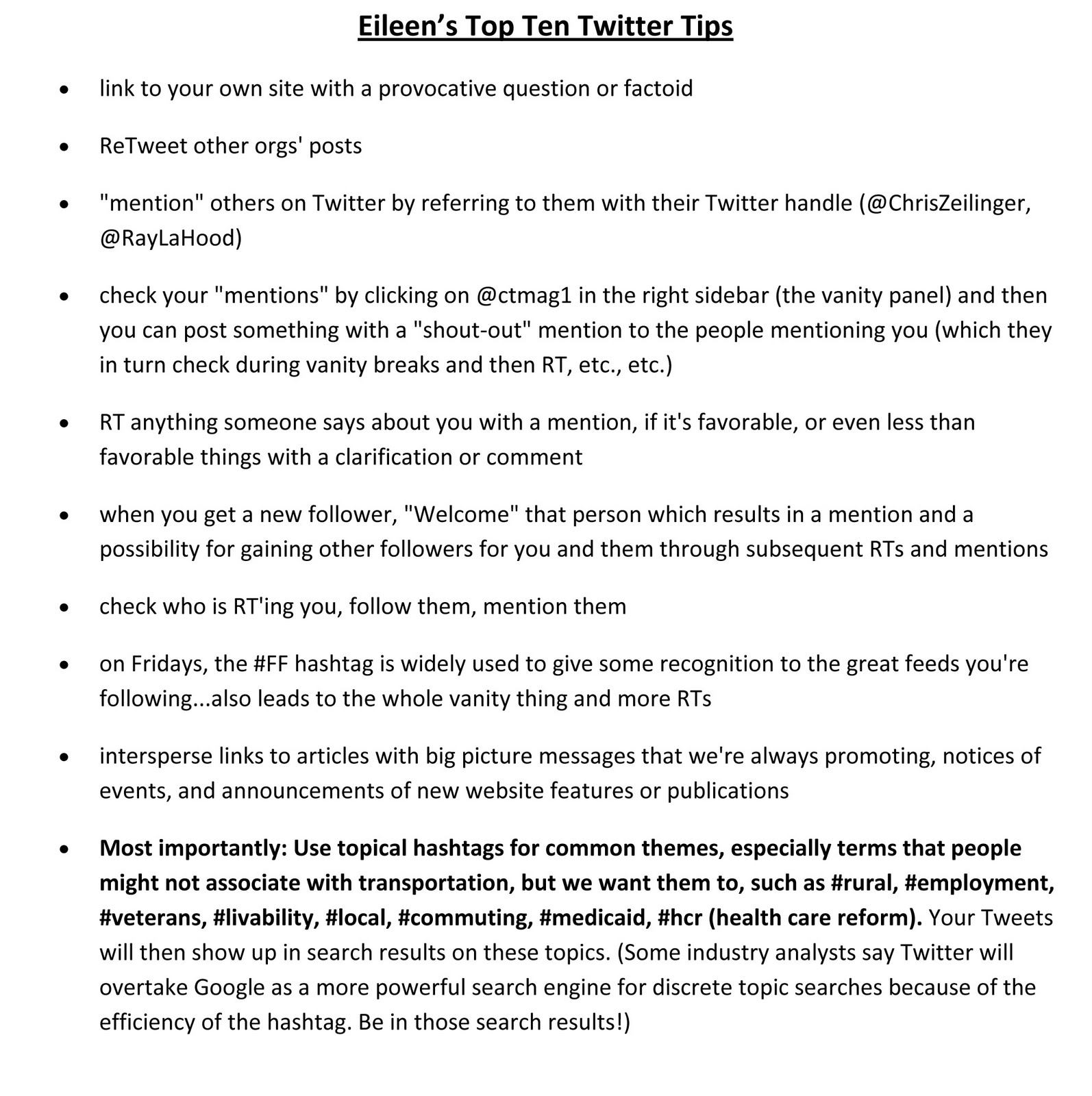
We made a list of all the current or proposed blogs and Twitter feeds that we know of and talked about the next steps for an approved social media policy. We also discussed the power of the hashtag and my top ten tips for building a following. The two best rules of thumb that I heard mentioned, for both blogging and microblogging were these: "Assume the whole world is watching," and "Be interesting." I felt these were great guidelines to get the most out of the tools and avoid most of the common pitfalls. It was a great first meeting and I hope to have more of them to blog about!

October 6, 2010

Greatest Hits

It's time to talk about hits--great ones if you'd like--but more importantly, the kind generated by Google bots and the ones oft' overestimated by your staff as genuine human interest in your web content. Lately, everyone's favorite word seems to be "hits." I keep finding myself in meetings where someone asks breathlessly, "How many hits are we getting on that page? Have our hits gone up? Are you tracking?" If you hear one of these questions, take a deep breath, put your enlightened librarian face on, and calmly explain the following:
  • A 'hit' is not as easy to define as some might think. Your own web system may define it differently from services such as Google Analytics, and you may have to wade through your server logs and crunch the numbers yourself to get an accurate count. (I'd say more, but I obviously don't know any more than this; I rely on our webmaster to interpret the server logs.)
  • Your own hits may be included in the numbers you are looking at. I don't know about you, but every time I am building a page, I check it several times in several browsers because I don't trust the preview screens. All those hits and refreshes (to fix apostrophes that are turning up as question mark diamonds) may be counted as veritable web traffic to a page. Which brings me to the next point...
  • You need to create a baseline to make sense of the numbers. You may choose to start tracking hits or growth after a certain date to filter out some of the set-up hits, especially if the page in question is brand-new. If the page is not a brand new URL but you have changed or added content, then it becomes even more important to think carefully about the date ranges you want to look at.
  • Don't track hits on pages you do nothing to promote. Marketing may not be in your job description, but if someone is asking you how a page is doing, and that page is not either (a) linked very prominently on your site, or (b) being actively promoted through some other method, do not spend time looking at the numbers until you've made some effort to drive web traffic to that page.
  • Be clear on what you are looking for in the numbers. Have you ever heard that HITS stands for 'How Idiots Track Success'? (I originally heard this attributed to Gerry McGovern, and it has also been attributed to Google's Avinash Kaushik, but I'd like to think it was first coined by Toby Ward.) I don't know if I truly believe that, but I think the extreme point of view occasionally helps move us to a more reasoned middle ground. Yes, you want to know if people are using your site, but hits could be bots not people, and even if the hitmakers are human, do you know how satisfied they were with your content? As JD Roth says, "Do you know the best way to get search engine traffic? Get linked from other sites. Do you know the best way to get linked from other sites? Write content that people want to share with others, content that makes people go, “Wow. I’m glad I found that.” That’s only SEO trick you need to know."
A website is a means to an end, not an end in itself. If you throw out some numbers that indicate page traffic is up, the temptation may be to think everyone is doing his or her job. Other forms of feedback and evaluation may be more effective unless your goal is just to generate hits. Let's leave that to the great songwriters of the world.